
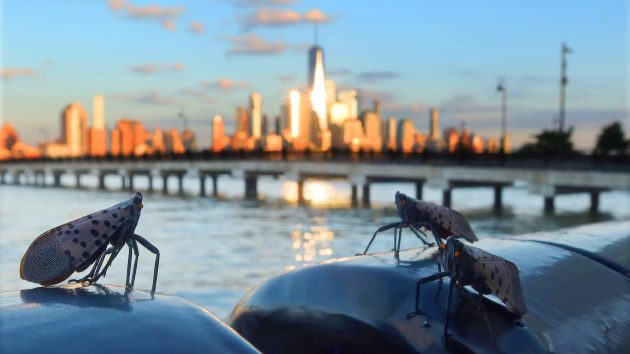
(NEW YORK) — Scientists are getting a better understanding of why spotted lanternflies, the invasive species wreaking havoc in the Northeast every spring, have been thriving since their invasion into the U.S.
The flying insect, identified by its distinctive spotted wings, originated in Asia and likely arrived in the U.S. around 2014 through a single introduction, after which it began to multiply exponentially, Kristen Winchell, an associate professor of biology at New York University, told ABC News.
Ever since, the lanternflies have swarmed urban regions in the Northeast, while wildlife experts have encouraged people who come across them to squish them immediately to further prevent their spread.
Researchers say they now have a better idea of how the insects have managed to adapt and spread so quickly in the U.S.
New genomic analyses of the insect indicates that the spotted lanternflies likely adapted to urban settings in Shanghai, China – including heat, pollution and pesticides – which is allowing them to thrive in the Northeast U.S. corridor, according to a paper published in The Royal Society journal. The insects showed adaptations in genes associated with stress response, according to the paper.
“They were adapting to thrive in urban environments in the native range, and that primed them then to be successful in whatever the next urban environment they landed in,” said Winchell, who co-authored the paper.
Researchers believe the lanternflies arrived in Berks County, Pennsylvania, in a shipment of stone from South Korea via their native range in urban Shanghai, Fallon Meng, a doctoral candidate at NYU’s Department of Biology, told ABC News.
Their egg masses have easily survived the harsh Northeast winters, so they would have “no problem” surviving in a climate-controlled shipping container, Winchell said.
Lanternflies have been spotted as far north as Boston, Mass., and Providence, R.I., although how much farther north they can survive is yet to be determined, Winchell said.
Spotted lanternflies were able “take over” an unfamiliar ecosystem and a new climate despite the low genetic diversity from the single introduction, Winchell said. They are genetically similar across their 125-mile range in the U.S., the research found.
“The loss of genetic diversity in this population, which should theoretically constrain any sort of adaptation or variation in traits in the invasive environment, should possibly limit their spread,” Winchell said.
The insects have also been known to hitch rides on trains and ferries, as well as humans’ backpacks, Winchell said, adding that researchers expect them to spread west next, toward Chicago.
“The females carry a lot of eggs, and so it just takes one to lay a successful clutch of eggs,” Winchell said.
Spotted lanternflies feed on tree sap using piercing mouthparts. The piercing doesn’t necessarily damage the trees, but their excrement, which is high in sugar, stains the trees and blocks photosynthesis, which eventually suffocates the trees, the researchers said.
Tree of Heaven, an invasive species in the U.S. that’s native to Asia, is their tree of choice, but they have the potential to impact apple orchards, maple trees and vineyards in the Northeast.
They can also sequester toxins from the Tree of Heaven, which makes them toxic to certain animals that may eat them, which in turn negatively impacts the food chain.
Invasive management efforts in cities may be necessary to curb further spread of the spotted lanternfly, according to the paper. In the meantime, researchers said, the the advice to stomp on them when you see then still stands.
Copyright © 2026, ABC Audio. All rights reserved.